The life of Woyzeck is a painful poem of individual tragedy, an endless experience of humiliation and mistreatment that leads to disintegration and self-destruction.
Through the transformation of Georg Büchner’s play, adapted by playwright Jack Thorne, Zana Hoxha brought a contemporary and universally poignant version of this story, turning Woyzeck into a symbol of dehumanization and alienation.
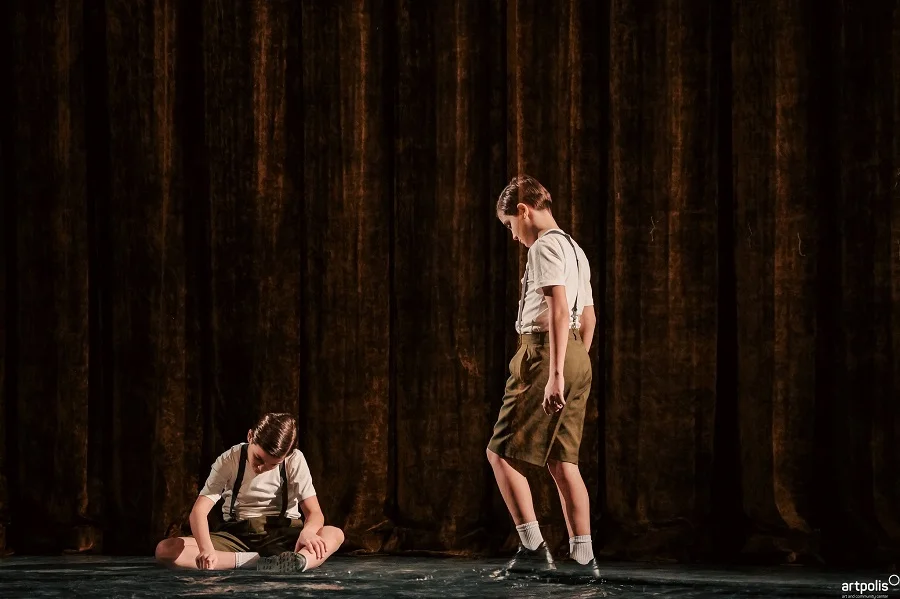
On February 21, 2025, at the “Hadi Shehu” Theater in Gjakova, the performance offered a profound reflection of the dehumanized individual, where every scenic detail mirrored the torment of a man losing his grip on reality. Hoxha’s direction focused on the psychological state of the protagonist, illustrating how, through an endless cycle of violence, he loses not only his identity but also his ability to act as a free individual.
Woyzeck’s fate is predetermined: the violence and trauma he endured from childhood lead him toward a tragic end. He becomes an object of experiments and a voiceless soldier. Woyzeck is a victim of a world that uses him but refuses to accept him as an equal.
In the stage design conceived by Grace Rumsey, everything is shrouded in an invisible darkness. Cold colors, plastic materials, and objects create a rigid atmosphere, symbolizing the imprisonment of the individual. This is a place where freedom does not exist, and every step is trapped in the gears of a system that excludes a person from any possibility of living as a complete individual.
Despite the tragedy it portrays, the performance is not just a portrait of Woyzeck but also an alarming call to society. It reflects the consequences of what can happen when humanity loses its connection to humaneness and fundamental rights.
“Woyzeck” left a deep resonance with the audience, raising important questions about social injustices, violence, the alienation of the individual, and, above all, the importance of mental health and the collective responsibility we bear as a society.
Around 580 people in the audience had the opportunity to attend the premiere of “Wojzeck”.
This performance is a co-production of the “Hadi Shehu” Theater and Artpolis supported by the Municipality of Gjakova and UNFPA.
On December 27, 2024, in the premises of Hani i 2 Robertëve in Prishtina, a powerful voice was raised against silence and taboos.
“The Vagina Monologues,” a stage reading based on Eve Ensler’s iconic text and directed by Zana Hoxha, brought to the spotlight stories of women who challenge censorship and misinformation in a society where sex education continues to be a taboo topic.
Through the extraordinary performances of actresses Ilire Vinca, Sheqerie Buqaj, Qendresa Kajtazi, Xhejlane Tërbunja, Zana Berisha, and Blerta Gubetini, the audience was immersed in bold narratives that transcended marginalization and stigma. Each monologue was an act of emancipation, a call to reflect on bodily freedom and the transformative power of words.
This event, organized by Artpolis with the support of UNFPA, was more than just a cultural occasion. It was an effort to create a space where the unspoken could be heard and where sexual education was addressed as a fundamental issue for a healthy society. In the discussion that followed, moderated by director Zana Hoxha and featuring panelists Mirishahe Syla and Adelina Berisha, the challenges faced by women in Kosovo were thoroughly articulated, especially against the backdrop of rising anti-feminist movements. The panelists highlighted the danger of regressive norms re-emerging and underscored the importance of coordinated and outspoken activism.
The stage reading offered a profound reflection on society’s relationship with the female body—not merely as a physical entity but as a symbol of resistance and independence. In an era where women’s bodies continue to be a battleground for ideological and political conflicts, this text reminds us that the power of words is a vital tool for liberation. The Vagina Monologues emerged as a delicate yet powerful portrayal of pain and triumph, prompting deep introspection about our roles in the pursuit of equality and justice.
At its core, this event was an act of solidarity—a reminder that stigma and silence can be shattered. The Vagina Monologues served as a transformative experience, a powerful testament that speaking out is an act of courage and freedom.
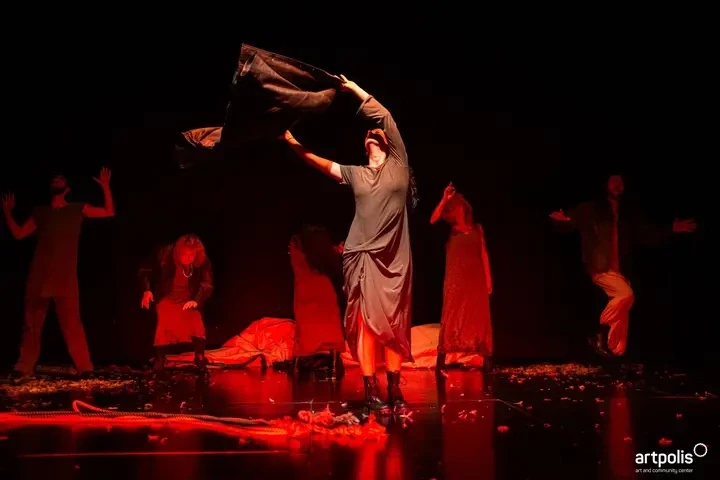
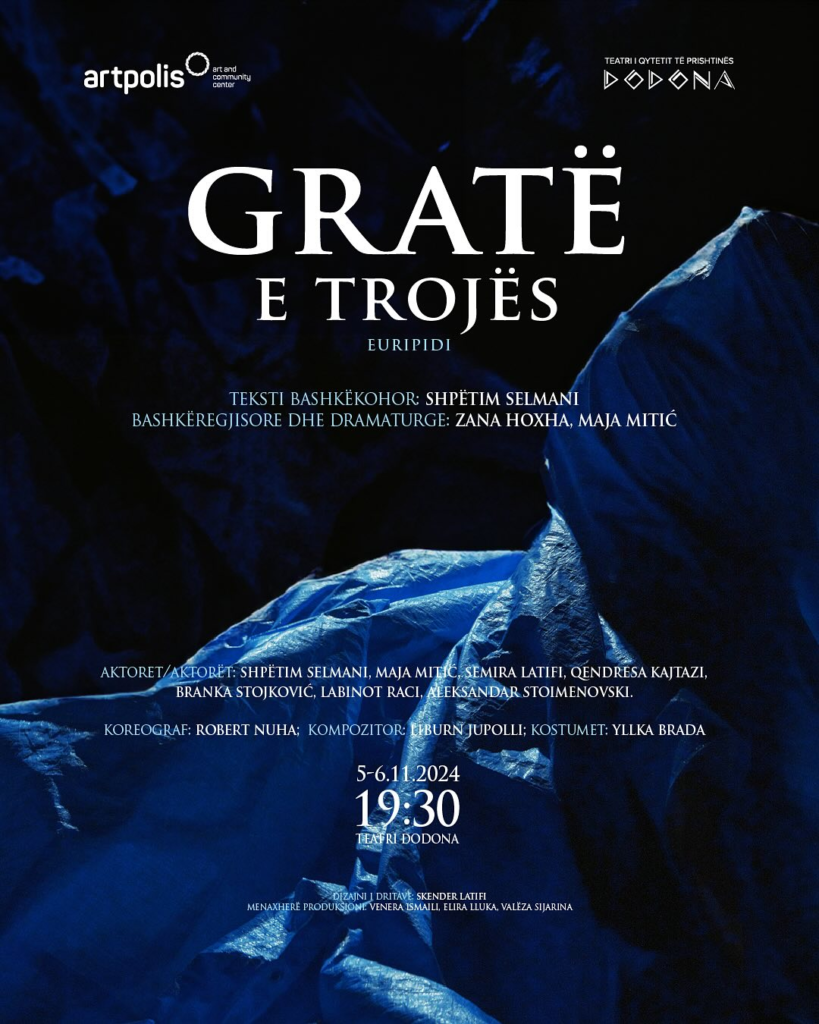
On November 5, 2024, the premiere of Women of Troy took place at Dodona Theatre in Prishtina, followed by a rerun on November 6. This powerful theatrical production, co-directed by Zana Hoxha and Maja Mitić, brought to the stage a feminist reinterpretation of Euripides’ tragedy, shedding light on the enduring trauma of war and the resilience of women who confront its horrors.
Following its debut in Prishtina, Women of Troy traveled to Belgrade, where it was performed on November 22 and 23, 2024, at the Center for Cultural Decontamination (CZKD). Over four performances, more than 370 audience members experienced a production that turned the stage into a space for reflection, mourning, and resistance. In a world still witnessing the devastation in Gaza and Ukraine, the production resonated deeply, serving as both a mirror to history and a call for peace.
Through a contemporary directorial vision, the play seamlessly weaves narratives from ancient Troy to modern conflict zones—the Balkans in the 1990s, Somalia, and beyond. It reminds us that war does not end with the silence of weapons; its wounds linger for generations. Women of Troy amplifies the voices of women who, across history, have endured displacement, loss, and oppression, yet continue to fight for dignity and justice.
The figures of Hecuba, Cassandra, and Andromache transcend the realm of ancient tragedy, embodying the suffering of women today. They are mothers mourning their children, daughters stripped of their future, and wives forced into exile. In war, they are seen not as survivors but as spoils—yet their voices, echoing across centuries, demand to be heard.
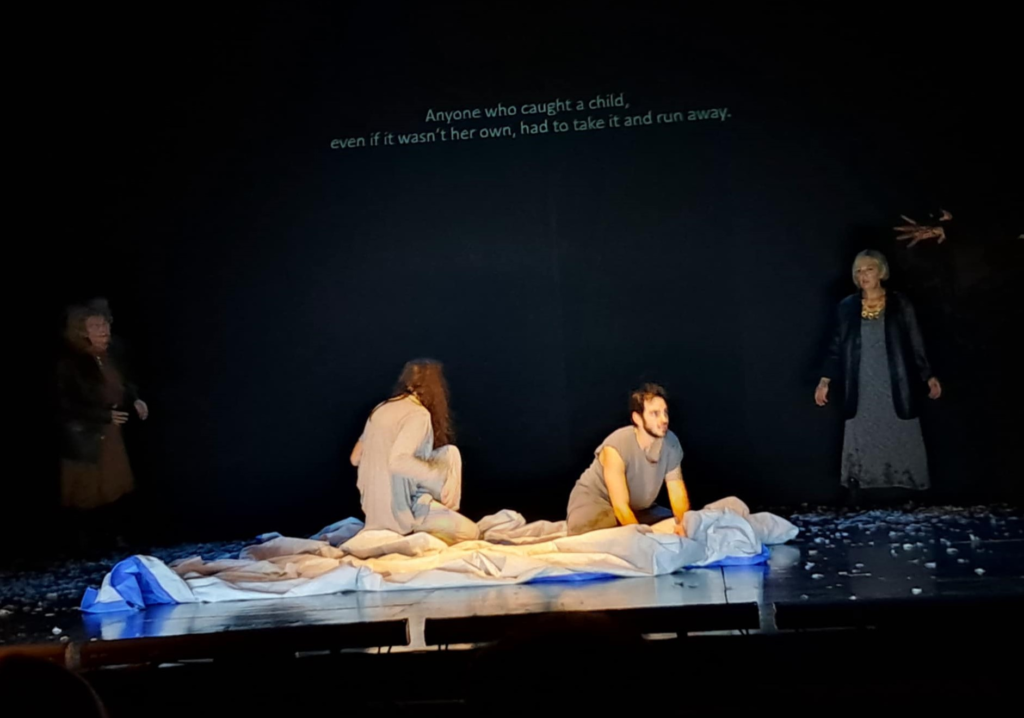
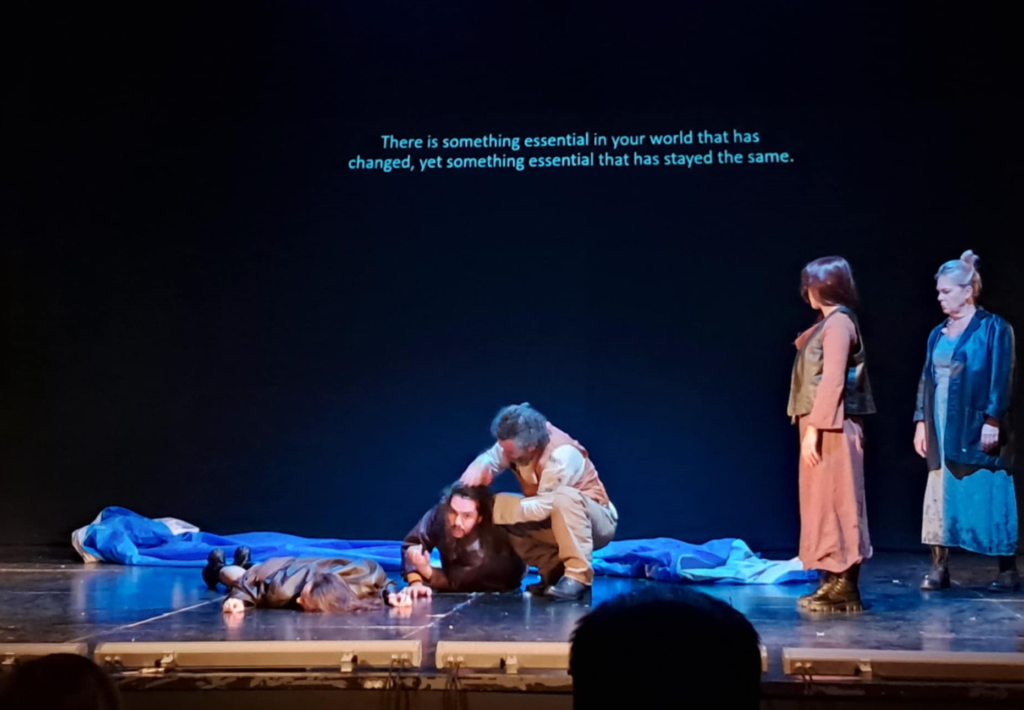
Performed in both Albanian and Serbian, with English subtitles, the cast featured Maja Mitić, Shpëtim Selmani, Semira Latifi, Branka Stojković, Qëndresa Kajtazi, Labinot Raci, and Aleksandar Stoimenovski.
A collaboration between Artpolis and the Helsinki Committee for Human Rights in Serbia, Women of Troy was made possible with the support of the European Union. However, the content of the performance remains solely the responsibility of Artpolis and does not necessarily reflect the views of the European Union.
More than a theatre performance, Women of Troy stands as a reminder, a reckoning, and a plea—a testament to the endurance of the human spirit in the face of war’s unrelenting cruelty.
Belgrade (AFP) – Maja Mitic is Serbian. Zana Hoxha is Kosovar. Their adaptation of an ancient Greek tragedy highlights not so much the devastation war inflicts on women but women’s capacity to heal and resist.
Euripides’s “Trojan Women”, first performed in 415 BC, is an acerbic condemnation of the atrocities of war. It focusses on the misery and injustices the women of Troy endure after the conflict between their people and the Greeks.
The adaptation that Hoxha and Mitic are currently staging in the Balkans has a quite distinct focus.
“In our version, we are moving forward by also taking care of each other, by finding ways to save our children,” said Hoxha, who directed the play.
It demonstrates “that amidst conflict and war, amidst hatred, women are the ones that find ways to resist,” she said of the play, being performed in Belgrade on Friday and Saturday night after two shows in Kosovo.
This production echoes the interminable discussions between the male politicians of Serbia and Kosovo who — a quarter of a century after the end of the war between Belgrade and its breakaway province — have still not concluded a lasting peace. The women negotiate on the soberly designed set.
As a Kosovar and feminist director “who still remembers war” and also the times of the former Yugoslavia, 43-year-old Hoxha said, “it was important to do this play because unfortunately it’s very relevant”.
Transcending language
In Euripides’s play, the women of Troy are married by force to their worst enemies, murdered and sacrificed on the tombs of men who fell in battle.
They are the victims of the war that follows war.
The tale needed two women to tell it, stressed Hoxha’s co-director Mitic, a prominent figure in Serbian theatre since the 1990s.
“‘Why are we suffering? Why do Cassandras have to exist today? Why does Andromache have to lose her child?”
At one point in the play, Hoxha recalled, Andromache says she wants to be able to walk around freely with her husband and son and not feel threatened in the street.
That feeling remains unchanged for women today, she said.
“There are only a few places in the world where I feel completely safe to be myself.”
“We are trying to change that,” she added.
“I don’t think that the performance alone can do that. But art has the power to bring you something which maybe you didn’t even know existed.”
The emphasis in Hoxha and Mitic’s adaptation on the universal relevance of the protagonists’ concerns extends as far as their costumes.
The characters dress in black leather and ankle boots — a uniform that could belong to any army in the world.
Just as Hecuba could be any grieving mother on the planet.
It’s a story about women and war “in any part of the world, in any century, in any culture, in any religion”, said Mitic.
“This is the story that Euripides wrote centuries ago, but actually we see repetition of the same model during the war, after the war — raping, criminals, everything.
“What we see in this play, we really see today (in) Ukraine or Gaza, or (in) Kosovo or Bosnia” or wherever conflict is occurring including Somalia and Sudan, Mitic said.
After an hour in front of a packed hall, the voices combine, hoping for another future: “Sometimes to live is to resist,” they say.
The dead are no longer affected, for fear, agony, and suffering weigh heavily on those who have survived. In a marked departure from Euripides’ original work, where the curtains fall on wail and tragedy, this performance brings hope through the interspersing of moments of humor.
Today, writing anti-war appeals may seem like the easiest thing to do. Unfortunately, there are times when it’s damn hard to draw the line between single-minded anger and bloodshed for moral capital, pretense for moral righteousness, or selfish self-affirmation. However, when calls against war are raised on the foundations of human suffering amidst the wreckage, screams, and sorrowful wails, great art permeates the human conscience deeply. Against the backdrop of relentless wars that plagued 5th-century Greece, Euripides gave voice to the shattered inner worlds of the unfortunate women and the all-encompassing nightmare of war.
Created in the distant year of 415 BCE, the play Trojan Women does not bring forth the heroic battlegrounds of Troy, the bold assaults on its walls and ramparts, the intrigues of the Gods, or the schemes of warring factions. Instead, Hecuba, Cassandra, Andromache, Helen, and the chorus of grief-stricken women emerge as the tragic heroines in the aftermath of a devastating war. Winners and losers alike stand before the heap of the dead, among whom are their dearest ones, and all that extinguished world that seems as though it never existed. Through his drama, Euripides breathed new life into the Homeric past, even its darkest side, to allude to the grim and terrifying present, where the Greek city-states, mired in wars with one another, were carving themselves an epitaph of shame.
Where Euripides only reluctantly showed any resistance to the Gods for their disregard, this performance from Prishtina, full of courage and without a trace of fear, boldly declares that religion itself is a factory of violence. The ruined world of Troy has victims on both sides, but the dead are no longer touched, for fear, agony, and suffering weigh most heavily on those who have survived.
Ancient Troy, Modern Troy
Euripides’ anti-war work carries timeless and universal resonances, but its reinvention with new language, fresh voices, and contemporary touches is a powerful invitation to sit, much like the ancient Athenian theatergoers during the Dionysian festival, and experience Euripides’ latest production. Such sensations are also embodied in the theatrical performance “Women of Troy”, co-directed by Zana Hoxha and Maja Mitić, which for the second consecutive year was presented at the Dodona Theatre in Prishtina. Originating from a collaborative creative process between Prishtina and Belgrade, the two-night performance, held on November 5th and 6th, highlighted an intricate performance by the artists of the Artpolis ensemble and their colleagues from Serbia.
As early as 1965, Sartre made an adaptation of this ever-relevant drama, which served as a powerful protest against the war in Algeria. Recently, writer and actor Shpëtim Selmani took on this challenging endeavor, infusing it with a local flavor while maintaining a universal resonance. His text preserves the original framework with gods and mortals, yet its dramatic update reverberates widely in the realities of our time.
Through the voices of female characters trapped in their own misery – like the sorrowful Hecuba, the unfortunate Andromache, the doomed Cassandra, and the defiant Helen – he unravels the unceasing pain of Kosovo, with the screams, tears, and suffering of the 20,000 women who were victims of sexual violence during the war.
“All happy families are alike; each unhappy family is unhappy in its own way,” said Tolstoy, with which he opens his novel on the psychological unraveling of his modern heroine, Anna Karenina. These words could somewhat be adapted here to say that every human pain has a unique mark, one that requires effort to grasp the inner world of disintegration and psychological ruin, which often goes unnoticed.
While the στιχομυθία (stichomythia) of the Euripidean original speaks in modern language, it simultaneously gains strength against war and its atrocities. This is most clearly expressed through Selmani’s monologues (who is also part of the cast). The intertwining of two different eras is masterfully balanced through the breaking of the “fourth wall” and occasional modern references: “The whole world is our ancient Troy and your modern Troy. Thousands of horses, not made of wood, but of steel… flying. Iron Pegasi dropping bombs here and there.”
The living suffer
Beyond its technical aspects, the performance as an undertaking is far more demanding than one might expect. In addition to the challenges of a still difficult neighborhood filled with grudges, prejudices, and hostilities, “The Women of Troy” also faced an additional issue. Would the two languages of the performance, Albanian and Serbian, complement each other? As a bilingual production, the work of directors Zana Hoxha and Maja Mitić deserves nothing but praise. The bilingualism is so seamlessly integrated through the interaction of a carefully chosen cast, including Maja Mitić, Shpëtim Selmani, Semira Latifi, Branka Stojković, Qëndresa Kajtazi, Labinot Raci, and Aleksandar Stoimenovski. Therefore, it can be freely said that neither the local audience nor the foreign one could notice any inconsistency.
There are two scenographic details that truly deserve recognition: in the opening scene, sea waves are improvised, from which Poseidon emerges, mourning the fall of Troy. Combined with the sound effects of the roaring sea waves, this creates a profound sense of utter hopelessness in the face of a merciless and mute providence that has abandoned the mortals. Throughout the performance, periodically, pendants appear suspended in the air, an element that aligns with the bitter and anguished faces of the unfortunate women, emphasizing the fragility of their lives. In truth, these are marvelous directorial strategies that use such elements to highlight the heroic efforts of the women against the all-powerful forces.
In the original Greek, almost every declamation of the female characters contains bursts of pain and sorrow (in the original, there are countless instances of wailing sounds such as aiaí aiaí, ottototototoí, ió ió, aiaí, and é é, which, in Euripides’ time, were realistic evocations from daily life). While the agony of these tragic women lingers in the air, the performance as a whole is a beautiful interplay between striking dialogues, a simple yet captivating set, and music that captures the contrasting and ever-changing states of the characters.
It is a blend of Euripidean verses with entirely modern evocations, highlighting the tragic fate of the 20,000 women who were victims of sexual violence during the war in Kosovo. This mental and physical juxtaposition is best expressed by Andromache: “They forced me to live.”
It often happens, especially in moments of agony that deep existential bursts emerge: “Only the dead do not feel pain.” Where Euripides hesitantly expressed any opposition to the gods for their disregard, this performance from Prishtina, full of courage and without a trace of fear, boldly declares that religion itself is a factory of violence. The shattered world of Troy has victims on both sides, but the dead are no longer affected, as fear, agony, and suffering weigh most heavily on those who have survived.
With a notable departure from Euripides’ original work, where the curtains fall with wails and tragedy, this performance brings hope through the insertion of moments of humor. This is another example of breaking the “fourth wall,” where the author and actor, Shpëtim Selmani, revives a scene reminiscent of Woody Allen’s “Deconstructing Harry”: out of nowhere, he comes face to face with his real-life characters, full of quirks, who complain about the fates he has assigned to them. Therefore, where there is hope, there is life!
The most tragic story of the conquest and destruction of ancient Troy is reflected in the captivity of the Trojan women by the Greeks; Queen Hecuba, Cassandra, Polyxena and Andromache. Immortalized with the tragedy “The Women of Troy”, written by Euripides, after the end of Troy they are separated from the kings of the Greek princes as spoils of war-captives. This painful story has served the Center for Arts and Communities, “Artpolis” and a group of artists from Belgrade (Serbia) to create theater performance “Women of Troy”, showing that pain and the Trojan reality continues to live even in our time.
With dramaturgy and direction by Zana Hoxha and Maja Mitić, and with a contemporary text by Shpëtim Selmani, “Women of Troy” was shown on Tuesday 05.11.2024, at the “Dodona” Theater in Prishtina. Staged by Albanian and Serbian actors, “Women of Troy” revealed the suffering of women after the war, highlighting the violence and brutality towards them. The special feature of the show is that the Albanian actors speak Albanian, while the Serbian ones speak Serbian, throughout the show, subtitled in English. The show brings, through a feminist approach, the sensitivity and resistance of women in the face of the terror of war, from ancient Greece to the present day, where wars are the havoc The Trojan women travel back in time, re-enacting the tragedy of women who experienced the last war in Kosovo, the war in Gaza, Ukraine, and more.
The play calls for peace and an end to conflicts in the world, a call that received applause from the audience.
“Troy, a metaphor for today’s crimes”
The Serbian actress, Maja Mitiq, told KALLXO.com that “Women of Troy” talks about the war, which is currently happening in Gaza or Somalia, or the war during the 90s in the Balkans, in the former Yugoslavia. She says that art must win in the face of war. “I feel that art must always win, not war and not murder, rape, who knows how many artists these days from Gaza or Ukraine who are immigrants. We think about these people, they are from the war, they are immigrants, and that’s why I ask the screenwriter, why didn’t you include some gods from Greek mythology that could protect them a little bit, maybe we could stop these wars that are happening” – says Mitiq, who is also the co-director of the show, “Women of Troy”.
Mitiq says that “Women of Troy” will be presented on November 22 and 23 (2024) at the Center for Cultural Decontamination in Belgrade. According to her, it is difficult to bring war narratives through art. But, as he says, they are important topics for changing society. “I usually choose topics that are important for changing society, because I believe that I can make a difference,” Mitiq said.
Actor Shpëtim Selmani, who has dramatized the modern text of the play, told KALLXO.com that the purpose of the play is to show that Troy still exists today. “The idea of the play is to show that the suffering of women still exists, that today Troy still exists, in the various places where there are wars, stories that are similar to ancient Greek tragedies, we rely on the work of Euripides, ‘Women of Troy’, we have an interweaving with current conflicts and we connected the situations” – he said.
The challenge of bilingualism
Director Zana Hoxha told KALLXO.com that the show “Women of Troy” is the result of a long process of work. “It has not been easy, almost a year and a half, it is one of the most difficult processes I have done in my life,” she said. Hoxha added that even though the show is based on one of the Greek tragedies, it speaks about today’s reality.
“I didn’t want to run away from what’s happening, I couldn’t make ‘Women of Troy’ without updating it, without giving a part of Kosovo, Gaza, and what’s happening in the world today” – said Hoxha.
But, a challenge for her, it was the realism of a play where the Albanian actors speak Albanian, while the Serbian actors speak Serbian, throughout the play. But, thanks to her, this is a historic step. “Obviously, it has been challenging to work in two languages because none of the actors know the Serbian language, nor the Serbian actors the Albanian language. Only I know both languages and sometimes I gave the indications in all three languages, Albanian, English, Serbian” – she said.
The show “Women of Troy”, according to director Hoxha, will be shown in Belgrade, Serbia, on November 22 and 23 (2024). Meanwhile, director Hoxha has already received an invitation to participate in Italy for the next year (2025).








Recent Comments