
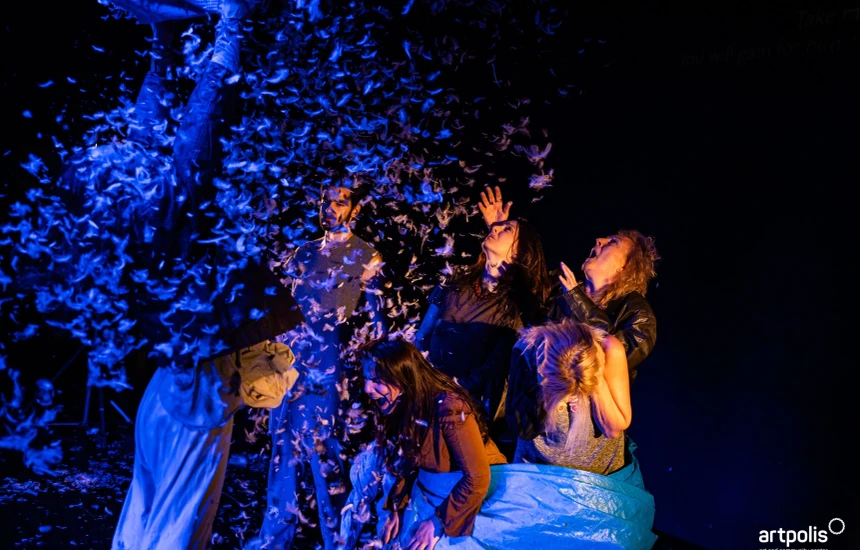
“The Trojan Women,” directed by Zana Hoxha and Maja Mitić, was staged at the “Tempora Contempora” festival in Lecce, Italy.
By: Besartë Elshani
The performance, which evokes the verses of Euripides and intertwines them with modern stories touching on suffering in Gaza, Ukraine, Somalia, Congo, and Kosovo, recently made its next stop in Italy. “The Trojan Women,” created through a collaboration between teams from Kosovo and Serbia, is already familiar to audiences in Belgrade and will return there in November as a work that, through the language of theatre, condemns what is happening in a world trapped in endless wars.
Kosovo’s enduring pain and the wound that still lingers today through the suffering of around 20,000 women who were victims of wartime sexual violence is one of the themes explored in The Trojan Women. The production was recently staged at the “Tempora Contempora” festival in Lecce, Italy. The collaboration between ArtPolis and the Serbian theatre company DAH Theatre, from direction to cast, became one of the main impressions left on the Italian audience.
This theme and this communication, transcending political borders through the language of theatre, will return to the heart of Belgrade in November.
The production evokes the verses of Euripides and intertwines them with modern stories. From the Trojan War thousands of years ago, the narrative extends to present-day suffering in Gaza, Ukraine, Somalia, Congo, and Kosovo—forming an endless cycle of tragedy.
Adapted by Shpëtim Selmani and co-directed by Zana Hoxha and Maja Mitić, the play is based on the Greek tragedy of the same title by Euripides.
Actors Maja Mitić, Shpëtim Selmani, Semira Latifi, Branka Stojković, Qëndresa Kajtazi, Labinot Raci, and Aleksandar Stoimenovski brought the story to life in Italy as well.
The Tempora/Contempora festival is described as an exploration of broad horizons that gives voice and space, “above all, to a new generation of artists and performers still unknown to wider audiences and the media.”
Co-director Zana Hoxha, who is also director of ArtPolis, explained that the play was very warmly received and deeply moved audiences in Lecce.
“One of the things that impressed audiences most was the connection with contemporary stories—the fact that the play begins almost four thousand years ago. It was written about the women of Troy, about women enslaved after war. But then we also bring today’s stories of war and conflict—for example in Gaza, Kosovo, and Cuba, which we used, as well as Algeria after the war with France according to Sartre,” she said in an interview.
The performance was staged at the cultural center Manifatture Knos last Thursday during the festival’s sixth edition, held from August 31 to September 6.
According to Hoxha, the production uses dramaturgical language to condemn the current chaos in the world.
“We condemn through dramaturgy what is happening today—wars that do not stop, pain that continues—and in a way we draw a parallel with the present. Audiences were especially impressed by how both teams appeared to have worked together for a long time; the cohesion among the actors made them seem like a single ensemble,” she said.
She also shared details about one of the real-life stories used in the production:
“We used the true story of a woman from Podujeva who was interviewed in the early 2000s by Associated Press. She described living alone with her parents. Her father was in a wheelchair when paramilitary forces entered and assaulted her in front of her parents. Her father later died from grief after the war, while her mother threw herself into a well because she could not continue living with what had happened. The woman herself continued to live on. Her parents suffered the consequences in different ways, which ultimately resulted in their premature deaths.”
This role is performed by Semira Latifi, who also portrays Cassandra.
“She says: ‘This is Cassandra of today,’ and ‘these are the twenty thousand Cassandras of Kosovo after the war,’” Hoxha explained.
A unifying feature of the production is that the characters communicate with one another without necessarily understanding each other’s language.
“The mother and daughter communicate with one speaking Albanian and the other Serbian, yet they understand one another as though they know each other’s language. The Serbian actors do not know Albanian at all. Throughout the entire project they understand each other through the language of theatre,” Hoxha explained.
The premiere of the production took place last October at Dodona Theatre in Prishtina. It was later staged in Belgrade at the Center for Cultural Decontamination in late November, where over two consecutive nights it presented, among other themes, the consequences of crimes committed by Serbian forces in Kosovo.
“When the play was performed in Serbia, many audience members heard for the first time that twenty thousand women from all communities had been subjected to sexual violence in Kosovo,” Hoxha recalled.
Now The Trojan Women will return to the Serbian capital after a year. In November it will be staged at Reflektor Teatar, whose mission is to promote “experimental, political, and innovative theatre forms, with a particular focus on independent performing arts scenes in the region.”
Many artistic productions from Kosovo traveling to Serbian cities encounter nationalist reactions. Last year, no such incidents occurred for the ArtPolis team, and Hoxha said they do not expect them this year either.
“In Serbia, the political situation is very sensitive right now. Student protests have continued for nearly a year. The situation is somewhat unstable and we will monitor it carefully. If it becomes dangerous for the team, I will not send them. But this is a festival organized by Reflektor Teatar in Belgrade, in a space intended for more open-minded and democratic people—not nationalists,” she said.
She described such incidents as staged.
“I believe there are groups in Kosovo and Serbia that sometimes stage incidents to gain greater publicity for a performance. We have never staged incidents and will never need to.”
And The Trojan Women still has more places to reach. Switzerland is among its next ambitions, pending confirmation.

